
Is Science the Contemporary Language of Wisdom?
On two different ways of knowing and where they meet.


There is a conversation that keeps repeating in intellectual circles, on Substack, in academic papers, in podcast interviews between neuroscientists and meditation teachers.
It goes like this: science is now confirming what the wisdom traditions knew all along. Mindfulness reduces cortisol. Compassion activates the vagus nerve. Meditation rewires the prefrontal cortex. The ancient and the modern are finally meeting.
The question underneath that conversation is worth asking directly: is science the contemporary language through which wisdom becomes accessible, or are they doing something different entirely?
The answer is both. And the distinction matters.
Two Starting Points
Science and wisdom are not two perspectives on the same territory. They are two different methods for two different kinds of knowing.
Science begins with what can be isolated, measured, and replicated under controlled conditions. The controlled condition is not a limitation. It is the method. Without isolation, there is no replication. Without replication, there is no science. This is what makes scientific knowledge trustworthy within its domain.
Wisdom begins somewhere else entirely. Not with isolation, but with integration. Not with the controlled variable, but with the living system in full contact with its conditions. The practitioner who sits for ten years is not running an experiment with controls. They are developing a capacity inside the uncontrolled complexity of an actual life.
These are not two roads to the same destination. They start from different questions and arrive at different kinds of knowing.
Three Territories
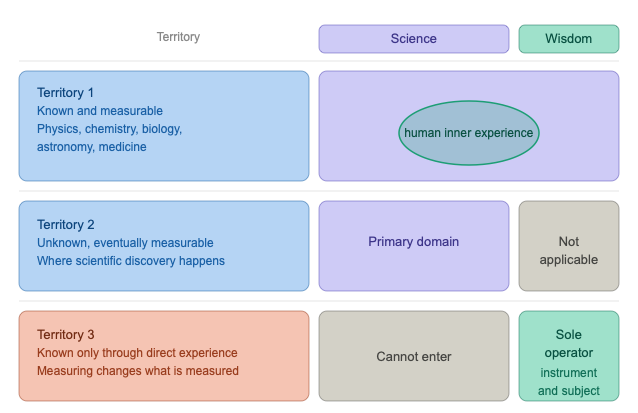
Knowledge has three territories.
The first: what is known and can be measured. Science operates here. This is its home ground.
The second: what is unknown but could eventually be measured. Science operates here too. This is where discovery happens. The microscope was not an ancient tool. The world of bacteria and cells was always there, but invisible until the instrument existed to detect it. The limit of what science knows at any moment is the limit of what its current instruments can reach.
The third territory is different in kind, not degree. It contains what can only be known through direct experience. Not because it is mysterious, but because measurement here is internal, not external.
Two people face the same situation. One experiences fear. The other experiences equanimity. The external conditions are identical. What differs is the internal state, which only the person living it can access. A brain scanner shows neural correlates of that state. It does not show the experience itself. Measuring body temperature tells you the temperature. Measuring brain activity during fear tells you something about the brain. It does not tell you what fear is from inside the experience of fear.
This is not a limitation of current instruments. It is a structural feature of the territory. The experience belongs to the person having it. No instrument positioned outside that person can fully access what is happening inside it.
Some fields of science study complex integrated systems — ecology, epidemiology, systems biology. These are important extensions of the scientific method. But even here, the study of inner human experience runs into the same limit: the researcher remains outside the phenomenon. The practitioner who has worked with fear directly, inside the conditions where it actually lives, knows something no external measurement can produce. Not more emotional knowledge. Different knowledge. Knowledge that can only be developed from inside the experience, not by observing it from outside.
That is the third territory.
The Part and the Whole
Science studies what it can isolate. This is the condition for replication. But it creates a structural limit when applied to living systems.
Physicist P.W. Anderson described it precisely: “The ability to reduce everything to simple fundamental laws does not imply the ability to start from those laws and reconstruct the universe.”
Salt is edible. Its components, sodium and chlorine, are a reactive metal and a poisonous gas. The properties of the whole are not present in the parts and cannot be predicted from them. Something new emerges at the level of the whole that was not there in any of the components.
Medicine shows this most clearly. A healthy heart is not a healthy body. Treating a condition at the organ level consistently produces effects at the system level that the organ-level intervention didn’t anticipate. Statins reduce cholesterol accurately. They also affect muscle function. Antibiotics clear infection accurately. They also disrupt the microbiome. The mechanism is correct at the part level. The whole system responds in ways the part-level study did not and could not predict.
Science organized itself through specialization. Each discipline studies its part precisely. Cardiology, neurology, gastroenterology, endocrinology. The whole organism, the person living an actual life, is never the unit of study. Integration across disciplines is the exception, not the design. Each discipline develops its own vocabulary. There is no common language for the whole.
Fear research shows the same pattern in real time. Neuroscience has been studying fear from the part upward for decades. First the amygdala was identified as the fear center. Then research showed the amygdala is involved in many emotional processes, not only fear. Then the ventrolateral geniculate nucleus. Then prefrontal cortex regulation. Then the insula. Each study adds a part. The mechanism is still being revised because the parts don’t assemble into a stable whole.
Vipassana practitioners have been working with fear from the whole downward for 2,500 years. The consistent finding: fear, when met with sustained non-reactive attention, reveals itself as intense sensation without the structure the mind built around it. The grip dissolves not because a brain region was targeted, but because the relationship to the experience changed. The practice works. The mechanism, in scientific terms, is still being assembled.
Two starting points. Two kinds of result. One is still mapping the parts. The other has been navigating the whole for millennia.
The limit of science is therefore not only a matter of instrument sensitivity. Even with perfect instruments, the whole of living experience exceeds what can be reached by studying its parts in isolation.
Science as Translation
This limit points at something important about what science actually does when it enters terrain that wisdom has already mapped from inside.
It translates.
When neuroscience identifies the brain mechanisms involved in the equanimity that contemplative practitioners develop, it is not making that equanimity legitimate. The practitioner had direct confirmation long before the scan. What neuroscience provides is language, a description of the mechanism in terms that can be communicated to people who need the cognitive bridge before they can access direct experience.
This translation function is more significant than it first appears. The wisdom traditions each developed their own vocabulary. A Buddhist practitioner, a Stoic philosopher, and a Kabbalist are often describing the same territory in completely different languages. Science, when it reaches that territory, provides a neutral language that none of the traditions owns. It creates a unified vocabulary across traditions that would otherwise talk past each other, and opens the territory to people who would not approach it through any single tradition’s language.
This is a real and valuable function. Not confirmation. Not validation. Translation and unification.
The map science draws is accurate within what its method can reach. The territory is always larger than the map.
Wisdom Is Not Proto-Science
The standard framing, wisdom anticipated what science would eventually confirm, contains a hidden assumption.
It positions wisdom as intuition that got lucky. As proto-science: things humans sensed before they had instruments to verify them. As a collection of insights that required scientific validation to become knowledge.
This misreads what wisdom actually is.
Wisdom is accumulated experiential knowledge confirmed over long periods of time. Farmers knew when to plant and when to harvest thousands of years before agricultural science existed. That knowledge was confirmed across generations, across geographies, without controlled experiments. When science arrived, it did not validate the knowledge. It explained the mechanism of something that was already working reliably for millennia.
The axiom in mathematics does not require proof. It is the foundation from which everything else is derived. Wisdom operates the same way. It has already survived the most rigorous test available: time, repetition, and immediate feedback on failure. What was wrong got corrected because the crops failed.
When Marcus Aurelius wrote that the obstacle is the way, he was not intuiting something neuroscience would later confirm. He was describing something he had tested directly, across decades of practice, inside the actual conditions of his life. The Stoic training was the methodology. The practitioner was both the instrument and the subject.
When Buddhist Vipassana practitioners documented that sustained attention on sensation dissolves the reactivity that suffering depends on, they were not anticipating exposure therapy. They were recording the results of a methodology developed over centuries, refined by thousands of practitioners, transmitted through lineages that functioned as quality-control mechanisms.
Science reaching these conclusions later is not validation. It is confirmation that science has developed instruments sensitive enough to detect at the edges of a territory that wisdom mapped from inside.
The Convergence Signal
There is one form of evidence the science-validates-wisdom framing consistently undervalues.
The wisdom traditions arrived at the same conclusions independently. Stoicism, Buddhism, Kabbalah, Vipassana, Taoism, Sufism. Different centuries, different cultures, different starting points, no coordination between them.
They diverge on metaphysical framework — on cosmology, on the nature of the divine, on what happens after death. Those divergences are real and significant within each tradition.
But they converge on the core structure: the person-centered reference point is the obstacle. What becomes available when it quiets is a different kind of knowing. The development of the practitioner is movement toward that quieting, not as mystical achievement, but as capacity developed through sustained practice.
The convergence is on the mechanism, not the metaphysics. And it is the convergence on mechanism that carries evidential weight.
A single randomized controlled trial with two hundred subjects runs once and gets published. The convergence of independent traditions across three millennia, each developing their methodology without knowledge of the others, each arriving at the same structural description of the same mechanism, is a dataset of a different order entirely.
Science has not confirmed this convergence. It has begun, slowly, to detect its edges.
The Frontier and the Consensus
Science is now producing researchers who arrive at Territory 3 from inside the scientific method, not by abandoning rigor, but by following it to the point where the current framework runs out.
Matthieu Ricard received his doctorate in molecular genetics from the Pasteur Institute, working under a Nobel laureate, then left to practice Tibetan Buddhism for decades. His conclusion, arrived at from inside both territories: “The third-person approach will never encounter consciousness as a primary experience.”
Donald Hoffman, cognitive scientist at UC Irvine and Troland Award recipient, has published peer-reviewed work on the foundations of perception and consciousness. His conclusion, arrived at through evolutionary theory and mathematics: “It’s only when we really want to understand precisely how consciousness is related to brain activity that we realize, now we’ve got to up our game.”
Both are working at the exact boundary the article describes. They do not represent the scientific consensus. Frontier work rarely does, until it becomes the norm. But what they find at that boundary is not new territory. It is the same terrain that wisdom traditions have been mapping for millennia, from the other direction.
Two Different Starting Points
The conversation that keeps repeating, science and wisdom as two sides of the same truth, is worth replacing with a more accurate description.
Science operates in the first two territories. It produces trustworthy, replicable knowledge of what can be isolated and measured. Within that domain, it is the most reliable method humans have developed.
Wisdom operates in all three. Its methodology is direct experience, developed over time, inside the actual conditions of a life. Its replication logic is convergence across independent traditions. Its quality-control mechanism is the practitioner’s own developed capacity to distinguish what is actually true from what is merely believed.
So is science the contemporary language of wisdom?
Partly. When science enters terrain that wisdom has already mapped from inside, it functions as translator and unifier. It gives language to what was already known through direct experience. It describes the mechanism of something that was already functioning before the mechanism had a name. It creates a shared vocabulary across traditions that each carried the same knowledge in different words.
Science is a language for the edges of that territory, not for all of it. The third territory, what can only be known through direct experience, where the knower must change to know, remains beyond what the language can fully describe. The map science draws is accurate within what its method can reach. The territory is always larger than the map.
Both are needed. Science reaches what wisdom cannot measure. Wisdom maps what science cannot enter. The relationship between them is not confirmation, and not competition. It is translation: science describing in its own language what direct experience already confirmed, and in doing so, building a bridge between traditions that were always pointing at the same thing.
Which of the things you are certain about came from measurement, and which from experience?