
The Tool That Shapes What You Can See
Waking up to your own life · Part 4

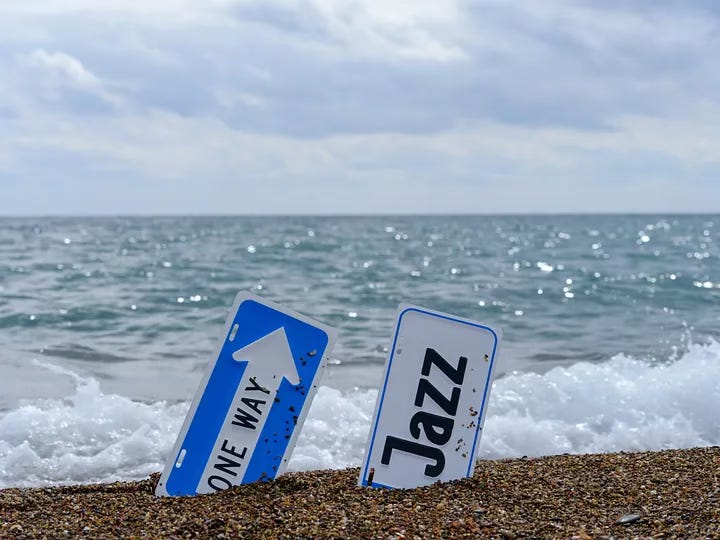
Language has one job: divide the whole into manageable pieces and put labels on them.
This is genuinely useful. You can’t solve what you can’t name. You can’t communicate what has no word. The label creates the handle — something to grip, to think about, to pass to another person.
But the division has a cost that almost nobody notices.
The sampling problem
Engineers who work with audio know this precisely.
An analog signal is continuous — infinite resolution, the complete wave. A digital signal is sampled — divided into discrete points at fixed intervals, then reconstructed. The reconstruction is functional. But information between the samples is lost. The digital version is never the original signal. It’s the best approximation the sampling rate allows.
Language does to reality exactly what digitization does to an analog signal. The labels are the samples. Reality — continuous, undivided — is the analog original. The labeled map is the digital reconstruction. Functional. Useful. But missing everything between the samples.
Show the same picture to two people. Ask them to describe it. Two different descriptions — not because they saw different pictures, but because their labels are different. The picture is one. The descriptions are many. Neither is wrong. Both are incomplete. The picture itself — undivided, unlabeled — is what neither description captures.
This is why art exists. Painting, music, poetry communicate precisely what language divides away. The feeling that has no name. The experience that exists before the label arrives. Art reaches what the division left behind.
When the label sticks
Here is where it gets significant.
The digital sample doesn’t just approximate the signal. It gets written to memory. In the brain, the same thing happens: once something is labeled, a neural pathway forms. Label something as “bad” — threatening, unfair, wrong — and Hebb’s law takes over. Every time the same input arrives, the pathway fires before any conscious evaluation. The label becomes the automatic response.
This is why suffering persists even when circumstances change. The situation changes. The label doesn’t. The neural pathway fires the same response to a new situation that only resembles the old one. The person is reacting to the label — not to what’s actually there.
The glasses from Part 3 aren’t just optical. They’re neurological. The filter is wired in.
And it compounds. The more the labeled response fires, the stronger the pathway gets. A relationship labeled “difficult” gets processed as difficult before the other person has said a word. A situation labeled “threatening” triggers the threat response before any real threat has been evaluated. The label has become the experience.
What gets lost
Most people navigate life entirely through labels. The labeled pieces — emotions, situations, relationships, problems — are what’s real. Everything else is vague, undefined, background noise.
But the most important signals are often in the unlabeled space. The background feeling that something is off. The body’s response before the analysis arrives. The sense of a situation that precedes the words.
These aren’t imaginary. They’re often more accurate than the labeled version that follows — precisely because the label hasn’t yet filtered them. But without a label, they can’t be held, examined, or acted on deliberately. They remain felt but unseen.
The incomplete map isn’t missing territory that doesn’t exist. It’s missing samples from territory that was always there.
The solution is the same tool
The way out isn’t new language. It’s the same labeling capacity redirected.
Instead of aimed exclusively at the divided pieces, aimed at what the division left behind. The background signal. The pattern running beneath the labeled events. The whole the pieces came from.
When someone says “I have a vibe about this” — they’re doing exactly this. Not a precise label. A reach toward the unlabeled signal that precedes the analysis. Imprecise, but pointing at something real that the precise labels missed.
The same tool. Different target.
This is why the series of articles you’re reading doesn’t offer techniques. Techniques are more labels — more division, more categories, more steps. What shifts is not a better label for the problem. It’s the capacity to sample what the labels have been leaving out — the background signal, the present moment, the pattern running beneath the named emotions.
Not new vocabulary. The same attention, aimed differently.
What in your own experience keeps signaling something you recognize but can’t quite name — something your current vocabulary has no label for?
New to AwareLife? Start here — the series reads best in order.